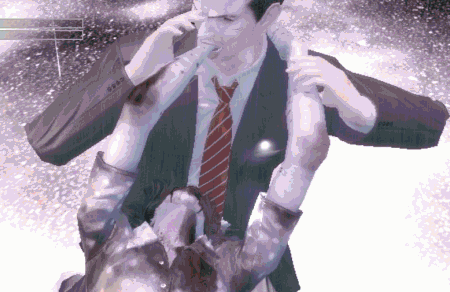
The good news is that the Brain Junkfoods are coming. I'm doing the What's Wrong With series, skipping "Sunnyville Yard Sale" for now. The reason is that I'm going to start doing Brain Junkfood videos soon, as well as Let's Plays. What's Wrong With series is going to be a little late.A Gamer's and Movie Watcher's Non-Professional Reviews and Rants Meant For Gamers and Movie Watchers.
Wednesday, March 28, 2012
News And Bits
The good news is that the Brain Junkfoods are coming. I'm doing the What's Wrong With series, skipping "Sunnyville Yard Sale" for now. The reason is that I'm going to start doing Brain Junkfood videos soon, as well as Let's Plays. What's Wrong With series is going to be a little late.Monday, March 26, 2012
Brain Junkfood: What's Wrong With This? Part One: Dead Space 2

There is no quicker way to earn my seething hatred than to take a good concept for a horror movie, game, book, etc, then put a dumbass twist in the end. Well, normally, that is true. Dead Space 2 jumped on the challenge wagon with the infamous "Your Mom Hates Dead Space" ad campaign. For those of you who don't know, the campaign was a "focus group" of mothers watching Dead Space 2, and commenting on how disgusting it, and people who play it, are. This was shortly after the ad debacle with Dante's Inferno, and after Visceral Studios and EA Games claimed that they would never advertise to children below the rating age. So, some genius decided to advertise in a way that would attract children. Having gone to school for graphic design and advertising, this tainted me from reviewing the game, ethically. Unlike IGN, I have ethics! Luckily, this isn't a review, nor completely serious. Without further ado, what's wrong with Dead Space 2?Friday, March 16, 2012
When It Rains, It Pours: Thoughts on Silent Hill: Downpour

While I will fully admit to enjoying most of the Silent Hill series (Silent Hill 2 being the exception of the main canon), I will have to admit that the series was long over due for a massive reboot, or an overhaul to say the least. Homecoming strayed far, focusing on combat over running, and Shattered Memories focused on changing the entire story. The less mentioned about that one, for me, the better, but that's a subject for another time. After Akira Yamaoka left Konami, and Vatra took over the development, I was, to say the least, anxious to see if Silent Hill: Downpour would even be up to par as a game, much less a Silent Hill title. And, I have to admit: I'm pleasantly surprised.
Sunday, March 11, 2012
I'm Commander Shepard, and This... Nevermind

Here at HyperPixel (where I'm working), we write articles for developers and fans alike, ranging from reviews to full articles. These include the one I just did about video games being art. Some of our upcoming reviews as a magazine will be SSX, Silent Hill: Downpour (which I'm writing), and Syndicate. Mass Effect 3 may not be on that list. The reason is a very bizarre one; we can't find a writer who isn't calling for BioWare's collective heads to be paraded before us on pikes.
Thursday, March 1, 2012
Entertainment for Art’s Sake; or Countless Tears Shed for Aeris’ Sake
The Commander was sent on a mission to destroy a sentient computer, only for the technology in her suit to get taken over. She fought through the hallucinations, destroyed the computer’s avatar, and watched as reality came flooding back. She saw an autistic man, David, hooked up to a machine, and his brother, a scientist, walk in. “It all seemed so harmless,” he started. He describes using his brother to communicate to with machines. The Commander called for her crew to pick David up, but the scientist protests. She punched him in the face, telling him that she’s taking his savant brother where he will be safe from experiments. As the Commander went to release David from the machine, he did his favorite mind-clearing activity: complex square roots. “The square root of 912.04 is 30.2.” He paused, though, adding, “It all seemed so harmless.” He repeated this over and over, tears flowing, until the screen went black (Bioware).
This was taken from Science-Fiction, but it was neither from a book, nor a movie. It was from the video game Mass Effect 2 from Bioware and Electronic Arts. If you asked anyone 40 years ago if this type of story-telling in video games would be possible, chances are that they would say that it would not. There are still people who deny that video games can be more than just a method of telling stories, as well as entertainment. The stigma of having the title “video game” does more than just hinder the true objective of what the designers, writers, and concept artists behind the scenes are achieving. But, what of the emotional responses the players have from forming a bond with their character? What of the philosophy and psychology involved in making a game that, for better or for worse, stands out in the minds of both player and audience? What of the art work and scripts that go into making the game? All of these gather to form only one simple conclusion: Video games are an art form, and do contain a meaning.
As of late especially, comparisons of video game stories to those of films have been drawn heavily. Roger Ebert has gone on the record to state that giving the player the power to make a main character’s decisions harms any artistic aspect of a game (Ebert). Game reviewer and writer Anthony Burch agrees with him, using the game Heavy Rain as a reference. In Heavy Rain, the player controls four characters, all of which are chasing a serial killer (Burch). The player can make several choices that change the story of the game. According to both Mr. Ebert and Mr. Burch, the fact that the player can make these choices change the characters entirely too much for the game to be art (Ebert, Burch). Mr. Ebert also adds that the interactivity of games diminishes them as an art form, as well as the fact that more than one person creates a game, therefore creating a mixed vision based on a group analysis.
How well does this line of thinking work for the players? There are people who play games solely for entertainment, but the same could be said about people going to the movies and books. Yet, movies and books are considered art. What’s more is that a group of people work on movies, to create the director’s vision. That does not render the work of the actors, writers, grips, and countless other behind the scenes workers invalid. They are the artists that bring the movie to existence as the director is the artist who brings them together. In terms of video games, you have the publisher that publishes and releases the game that a developer makes. The developer contains the core pieces of the game: the writer(s), concept artists, designers, texture artists, actors, musicians, etc. Most of these positions are found in the credits reel for movies as well. Individually, they would be thought of as artists. Why should it be different because they are in a group?
The advancements in cinema technology go hand in hand with those of game creation. Rockstar Games’ L.A. Noire was released in 2011, with a ground breaking technology that allowed players to actively judge whether a character was telling the truth or lying. The developers, Team Bondi, took this one step further by having certain characters act in an unusual manner. One such character, who is implied to be clinically insane, only tells the truth once when questioned, but acts the opposite way one would. He poses like a superhero, overly proud that he told the truth. Similar advancements are seen in movies to this day, including Pixar Entertainment’s (Bondi).
What of the choices though? In L.A. Noire, you have the choice to accuse the right or wrong person, be it intentionally or not. Those do not change the outcome of the entire game. The choices in Heavy Rain, on the other hand, do. The player can choose to have the father cut off his finger in order to get the clue to save his son, or walk out of the room (Quantic Dream). This can lead to the player getting a different ending in the game. Mr. Burch states that having the father walk out of the room is uncharacteristic of what he has done so far to save his son (Burch). From what little we know of him, he lost one son due to an accident, his second is kidnapped, and he is willing to jump through hoops to save him. But, how do we know for sure that he would cut off his finger instead of finding a different way? Ultimately, the player has known him for a small amount of time, and has been seen through the player’s eyes as more than just a person, but an extension to the player.
Even with the choices changing the ending of the game, as well as certain aspects, the core story stays the same. The same person will always be the killer, and the same scenes will play out in their order, only done differently depending on the player or play through. The character is still written to respond to these in a character specific manner, i.e. the father will see his inability to do what he can to save his son as failure, sinking him into a deep depression (Quantic Dream). In this sense, the game does not loose artistic merit as a whole, but each play through gains a different meaning.
To say that adding story changing choices to video games makes it not artistic means that the game would have to be devoid of those choices. In the case of Bioshcok, there are no blatant moral choices. The player character is guided by a voice over a radio, politely asked to grab a radio, help find his wife, and kill the creator of the underwater city of Rapture. Once the player reaches him, it is revealed that the choice was false all along, and the player was a toll to someone else’s means (2K). But, the game has another choice for the player to make that isn’t seen as changing the character.
Throughout the game, the player encounters “Little Sisters,” mutated children who are protected by monsters in wetsuits called “Big Daddies.” The player can choose to “harvest” the chemicals from the Little Sisters, leading to their deaths, or save them, at the sacrifice of the chemical (2K). These choices are to aid the player while still offering a slight moral choice. This choice changes the ending of the game, but nothing else. The difference is that in Bioshock, the character is a blank slate, whereas in Heavy Rain, they are established from the beginning. But, again, we only know what the game has shown us, not the true nature of the whole character. Ultimately, despite how established a character is in a game, the player molds them.
Bioshock as whole stands out as a philosophical argument of both politics and video games as an art form. The game is in a similar style to an Ayn Rand novel, speaking against government and religion in the form of Andrew Ryan’s utopia of Rapture (Tavinor, 91). It was meant to be a utopia for those who wish to be free of the government taking the fruit of their labor, as well as religion. Ultimately, it fell due to both the people’s need for control, and Ryan becoming what he despised the most: a dictator. These parts of the story are told within the game, via audio logs collected. In the case of Bioshock, the game is art in and of itself, not art placed into a game, because the story is told as the game.
L.A. Noire takes a different approach by having the player control Detective Cole Phelps on his cases, and showing in cut scenes why he is the over achiever that he is. Players see his cowardice in World War II, turning sympathy to betrayal (Bondi). Yet, the manipulation that is forced upon him still makes the player sympathize with him, thus making the ending even more tragic than it would be if he was just a straight shooter stereotype of a police officer. Again, the player has no choice in who the character is, nor the choices he makes, but they still form an emotional response to him.
But, what about a game where the character is a blank slate for the player to mold? In Mass Effect 2, the player can create their own individual character, or import the one they created in the first game. While certain sections of the story are prewritten, they player ultimately has choices to make throughout the game to alter the universe as well as the player-character. The player can have a romantic relationship with a team member, gain their loyalty, or have them die on the final mission. The player-character can even die in the final mission, and still win the game (Bioware). This creates not just a story that is a piece of art for an audience, but one that has an individual meaning for the player. That meaning can be one of selfless service, or one of martyrdom, or even one of betrayal. In that case, Mass Effect 2 creates a piece of storytelling not just on par with modern cinema, but a story that holds a potential individual meaning for the player that can change from player to player.
This obviously does not apply for all games, as the writers often times are telling a story in the way they want it to be told. “Winning” the game used to be a completely different concept, meaning an end to a game with a blurb that tells the player what happened to finish a story. At this time, the story was made only to motivate the player to play, i.e. save the princess. In our current generation of gaming, the story is much more than that. Characters have the essence of real people, allowing the player to form an emotional bond, not just with the main character, but with a non-playable character. Many a story has been written about the tragic death of Aerith Gainsborough in Final Fantasy VII, where players have admitted to crying at her death. Aerith’s character is both non-playable, and only in a small portion of the game, yet that much of an emotional response is now expected (Gale).
While seen as one of the most tragic deaths in gaming, Aerith’s is only skimming the surface of a larger, emotional vision in games. Games have reached a period where they can make statements on our world of the past, present, and possible future. But, they have also reached a point where they contain characters who elicit emotions, both by visually having them, and being voiced with emotions. The choices within the games create an individual meaning for the player, as well as on overall meaning for the mass audience.
A final example to point out is one an audience must see for themselves. A website contains an “experimental” game entitled Today I Die. Instead of manipulating the character per se, the player manipulates objects in the world to make words to replace the “dark” words with until the sentence changes to a positive sentence. The world changes with each word that is swapped. There are no choices, no modern graphics, and no voices to manipulate the player’s emotions; only the game and the computer. Yet, changing a sentence from a dead character to a free, living character can cause an emotional response, and leave a meaning with the player. To top it off, only one person made the game. If people are hesitant to deny that as art, why should mainstream games be any different?
Benmergui, Daniel “Today I Die” http://www.ludomancy.com/games/today.php?lang=en
Bioshock v 1.1 2K Games 2007
Burch, Anthony. “Why Heavy Rain Proves Ebert Right” http://www.destructoid.com/why-heavy-rain-proves-ebert-right-165034.phtml. February 26, 2010
Ebert, Roger. “Video Games Can Never Be Art” http://blogs.suntimes.com/ebert/2010/04/video_games_can_never_be_art.html. April 16, 2010
Gale, Paul. “Aerith’s Death is Still the Most Significant Death in Gaming” http://paulgalenetwork.com/home/2010/12/23/aeriths-death-from-final-fantasy-vii-is-still-the-most-significant-death-in-gaming/. December 23, 2010
L.A. Noire v1.1.2406.1 Team Bondi: Rockstar Games, 2011
Mass Effect 2 V 1.02 Bioware: EA Games 2010
Tavinor, Grant. “Bioshock and the Art of Rapture” Philosophy and Literature April 2009, Vol. 33 Issue 1. p91-106 16p
Wednesday, February 22, 2012
Brain Junkfood: Painkiller Blowout Part Three: Dreamkiller

It was once said that George Washington had holes drilled in his skull to relieve the pressure in his head. I never used to believe that. Then I played Dreamkiller. Let me put this in perspective: I just compared the stress of the first American President to playing a video game, and I'm completely serious. After playing this game, I feel like I need wooden teeth, and a shotgun while riding a cheeseburger eating robot wolverine. Only something that epic can redeem this mess of a shitty game.Friday, February 10, 2012
Non-Linear Path: Sequelitis
Call of Juarez was never an overwhelmingly popular game like Halo, but it was well received, spawning a sequel that explored the past of Reverend Ray. The theme of the Wild West was surprisingly unexplored for the first person genre, with a few exceptions which I may touch upon in a later article. Ray was well written character, one who was an outlaw set on a path to redemption through faith in God, to eventually being drawn back into killing for justice. I love that clip. While all of the characters are criminals you couldn't help but like them, even a little bit.
Then, The Cartel came, and ruined all of our fun. For starters, they ditched the western theme, and made a modern times shooter. You played as one of three cops, all of them not only dirty, but without any redeeming qualities. They also made it co-op first, single player second. This is an issue when you consider this: games created for single player primarily generally suffer from lackluster campaigns once multiplayer is added. Take a look Bioshock 2, a game that made multiplayer-centric, and changed the feeling of the game series by taking away all that was intriguing from the first game making the sequel nothing but a standard shooter, complete with boss battles.
The Cartel had a separate issue. We'll call it the "Dark as Cow's Guts" issue. The subtitles for the game suggest that it was written to be a Western, but was changed to keep up with other shooters, i.e. Call of Duty. This cost The Cartel more than just the series identity, it cost it the series' fan base. People saw just another modern shooter, and, let's face it, a terrible one at that. The rush showed everywhere from writing to AI to graphics. I really wish I had a picture of the rock that only had three textured sides to it. The game was loaded with glitches, as well.
Another issue I've seen is games that are attempts to improve on the last by trying something new. This isn't a bad thing, normally, but in one case, it killed the series. Yes, I'm talking about Saw II: Flesh and Blood. Zombie Studios attempted to fix the laggy combat controls by making combat a minigame. The issue with this is that the minigame's controls were unresponsive as well, namely due to a separate issue involved in programming. Needless to say, the fix didn't work, and served to draw the player away from the game.
There were also several issues with planning, including a puzzle that was supposed to have its solution located in a different room, but it wasn't. Again, the game was rushed to meet a deadline, namely to hit around the same time as the last movie. While that doesn't help matters, sometimes, it just isn't an excuse. They could've actually examined the combat system from the first game, and fixed it while keeping a combat system. This would've been easier than programming a completely different segment all together.
Despite these games, I have one that disappoints more than either of them. Save the flames for when I'm done, because I'm giving this game credit for improving its combat. Unfortunately, the rest of it isn't that good.
The Darkness II does a few things very wrong in comparison to the first game. I had a difficult time pinning down what exactly rubbed me the wrong way the most. Was it the fact that the free roaming and side missions were taken out of the game? They weren't that important to the first game in the first place, but you were rewarded by collectables and funny phone calls. Not to mention that you felt both like a mafia hitman and a good guy, instead of just being a killer.
Was it the controls that moved slowly when you tried to aim quickly? Sure it hurts the game, but does it hurt it enough to make it worth selling back less than a week later? How about the short single player campaign (I beat it in five hours), meant to make room for the multiplayer, which is only a hair more enjoyable than the actual game? Or the enemies with cheap tactics blinding you, stealing your weapons, and then moving just as you hit the trigger?
It hit me in the last hour of the game what left that bad taste in my mouth. It wasn't just all of the above, it was the story. The first game set itself away from the comic by making a more down to earth story, without supernatural enemies. You were the monster, but you had a heart. You were what people were afraid of, but there was a reason. You wanted them to fear you, especially after what the bad guys did. By the end, you're in control of the mob, and no one knows how other than you killed your uncle.
Somehow, though, your powers are no longer a secret. The mob knows you have them, and even comments about them. To make matters worse, a cult with your powers is trying to kill you. You have to rebuild your powers from scratch, no less, meaning you're vastly weaker than your enemies. This is an absolute contrast to the purpose of the Darkness. You're overwhelmed until the last hour of the game, changing what the meaning was.
The Darkness was about power corrupting and how to overcome it. Jackie was able to overcome the corruption and control it, while still being powerful. Yes, he had the Angelus trying to kill him, but she suffered much of the same issues. Jackie had to use his abilities to keep from being overthrown, and defend himself. Very few people lived if he was attacked, and even fewer if his friends were. But, most of all, he kept his technique secret.
All of a sudden, in the game, you're weaker than your enemies, and the world know about the Darkness. What's more is that more people than you have it, which doesn't make sense. Even in the first game, they mention only one person can have the Darkness at one time. Why does this cult have the powers, if I'm the host? I understand the need for balance, but the lack of it makes the game nearly unapproachable, even to watch it, if you know the source or played the first game.
This is a big issue with sequels. Often times, no one is aware of what the story is supposed to lead up to, its themes, or even its characters. Even good sequels have this issue. Silent Hill is a good example. After the development went from Japan to America, the psychological themes were less focused on than the combat. This could be a cultural change, as well as a change between an individual's vision of the series. It doesn't mean one is better or worse than the other, normally. This changes when the game is based on something that is established, it may be a different story.
That's all the time I have right now. Stay tuned for next time when I talk about Guilty Pleasures in gaming.